Which tractor is best for agriculture
Four jobs, four different answers, each read off the figure that actually governs it.
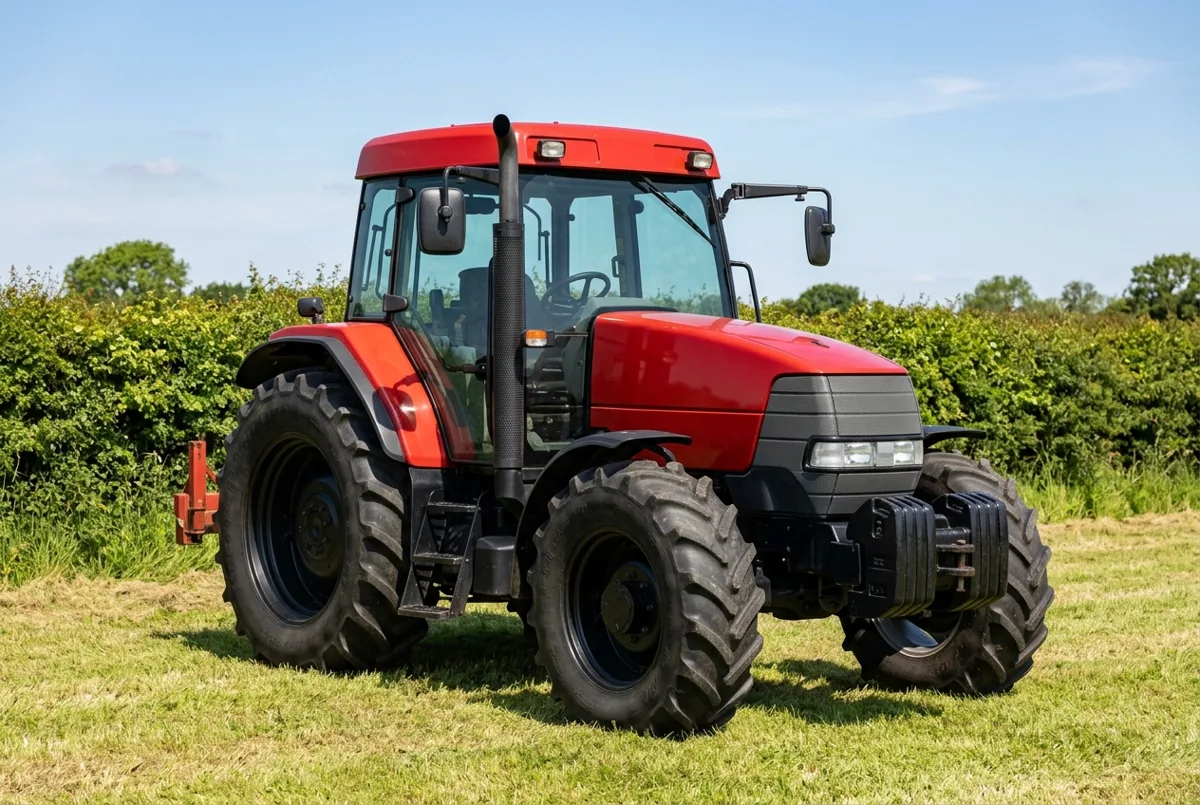
The Case-IH MX 100, one of the machines discussed below.
“Agriculture” is four jobs wearing one word. Ploughing, haulage, driving an implement off the power take-off, and loader work each ask a different thing of a machine, and a tractor that is excellent at one can be merely adequate at another.
So this article does not name a best tractor. It takes each job in turn and shows the figure that actually governs it, measured across our records. If you want the question answered by farm size instead, that is a different question and it is answered in which tractor is best for farming.
From our database
Every figure below is computed from published records with sourced specifications. Queried
2 October 2026. The PTO speed sets come from core.pto_speed_set(), our own published rule,
because the same fact is printed several ways in the sources — “540/1000 rpm” and
“540 rpm / 1000 rpm” are one machine specification, not two.
Power take-off: 3,063 machines, 13 distinct speed combinations.
- 1,489 offer both 540 and 1000 rpm — the combination that drives almost anything.
- 889 offer 540 alone. A 1000 rpm implement will not run on these.
- 288 offer 1000 alone, which is the opposite problem and catches people out more often because it is rarer.
- 304 offer an economy speed — 540E or 1000E, the same shaft speed reached at lower engine revs, which saves fuel on light work.
Lift: 2,045 machines publish a three-point lift at the lower links. Median 2,938 kg. 1,021 are at or above 3,000 kg and 386 at or above 6,000 kg.
Haulage: 3,223 machines publish a top speed. Median 30 km/h, with 574 reaching 40 km/h or more.
Two things worth taking from that. The PTO speed combinations are the most consequential specification nobody checks — nearly a third of the machines we hold cannot drive both common implement types. And the lift figures are published by about two thirds of the corpus, so the median describes most of it but not all, which is worth knowing before leaning on it.
What does ploughing ask for?
Weight and traction, in that order, and power third.
A plough is a draught implement: it is dragged, not driven, and what limits it is whether the tractor can transmit force to the ground without the wheels slipping. That is a function of weight on the driven axles and of tyre contact, which is why ballast exists and why a heavier machine out-pulls a lighter one of identical power.
Power still matters, but it sets the speed you can plough at rather than whether you can plough at all. The figure to compare is power at the shaft where a laboratory has measured it, not the engine figure on the brochure — those differ by 11.4% on average across the machines where we hold both, which is explained in why PTO horsepower is lower than engine horsepower.
What does power take-off work ask for?
The right speed, and enough of it.
This is the one job where a tractor can be simply incompatible with an implement rather than merely under-specified. A baler built for 1000 rpm will not run on a 540-only tractor, and 889 of the machines we hold are 540-only.
The second question is how much power reaches the shaft, because that is what the implement consumes. Our PTO horsepower list holds every machine for which a laboratory has measured it.
A worked example from our records. The Case-IH MX 100 is one of the most thoroughly tested machines we hold, with four independent laboratory reports behind its figures, and the John Deere 7810 is another. On machines like these you can read the measured shaft figure rather than inferring it, and the difference between that and the brochure is the difference between planning a job and hoping.
Economy speeds are the quiet improvement here. 304 machines offer one, and on light work — tedding, light mowing — they do the same job at lower engine revs and noticeably less fuel.
What does loader and lift work ask for?
Hydraulic capacity, and the right kind of it.
Two separate specifications govern this and they are routinely confused. The three-point lift figure is the rear linkage, measured at the lower links, and it governs mounted implements. A front loader is a different system with its own rating, and a big three-point figure does not promise a strong loader.
The median three-point lift across the 2,045 machines publishing one is 2,938 kg. Check it against the heaviest thing you intend to mount, with its contents, not against the tractor you are replacing.
Hydraulic flow matters as much as lift and gets even less attention. It decides how fast a loader fills and a tipping trailer empties, which on a busy day is the difference between one job and two.
The figure to be careful with is which pump the number describes. A tractor may publish a total pump output that includes the steering circuit, and the flow available at the spool valves — the flow a loader actually gets — is lower. Where our records separate the two we store them separately, and where a source gives one number without saying which it is, we say that rather than assuming the larger reading. The New Holland T4.75 is an example of a machine where the laboratory record is detailed enough to settle questions like this, with five separate test reports behind it.
What does haulage ask for?
Speed on the road and brakes that suit the load.
The median machine we hold tops out at 30 km/h, and only 574 of 3,223 reach 40 km/h or more. If a meaningful share of the work is road miles, that is a specification to shortlist on deliberately, because it is not the norm.
Weight returns here as a constraint rather than an advantage. A heavy tractor on the road is harder to stop, and trailer braking becomes the governing specification rather than the engine.
What should you check before comparing any two?
That you are comparing the same kind of number.
A manufacturer’s claimed engine figure and a laboratory measurement at the power take-off are different quantities, and a table that puts them in one column is describing its own sourcing rather than the tractors. Where both exist we publish both and label which is which. Our data methodology sets out how every figure here is sourced and what has to be true before it publishes at all.
Common questions
- What PTO speed do I need?
- It depends on the implement, not the tractor. Most mounted implements are built for 540 rpm and most high-draught or large machinery for 1000. Of the 3,058 machines where we hold the speeds, 1,487 offer both and 889 offer 540 alone — so a tractor that cannot drive your implement is a real possibility rather than a theoretical one.
- How much lift do I need for loader work?
- The three-point lift figure governs mounted implements at the back, not the loader at the front, and the two are separate specifications. Across the 2,042 machines publishing a three-point figure the median is 2,939 kg, and 386 are at or above 6,000 kg.
- Does a faster tractor make haulage cheaper?
- Only where the road allows it and the trailer brakes suit it. The median top speed across 3,215 machines is 30 km/h and 570 reach 40 km/h or more, so the faster machines are a minority and are worth identifying deliberately rather than assuming.
Sources
- Traktorenlexikon, the model articles cited on each tractor's page — Wikibooks, CC BY-SA 4.0. Retrieved . Original
- OECD standard codes for the official testing of agricultural tractors — OECD. Figures from these test reports are cited per machine on each model page, from the report records in our database; we hold no fetched copy of the OECD programme's web pages.