How tractor pulls work
Two machines, one chain, and a drag engineered so that nobody is supposed to reach the end.
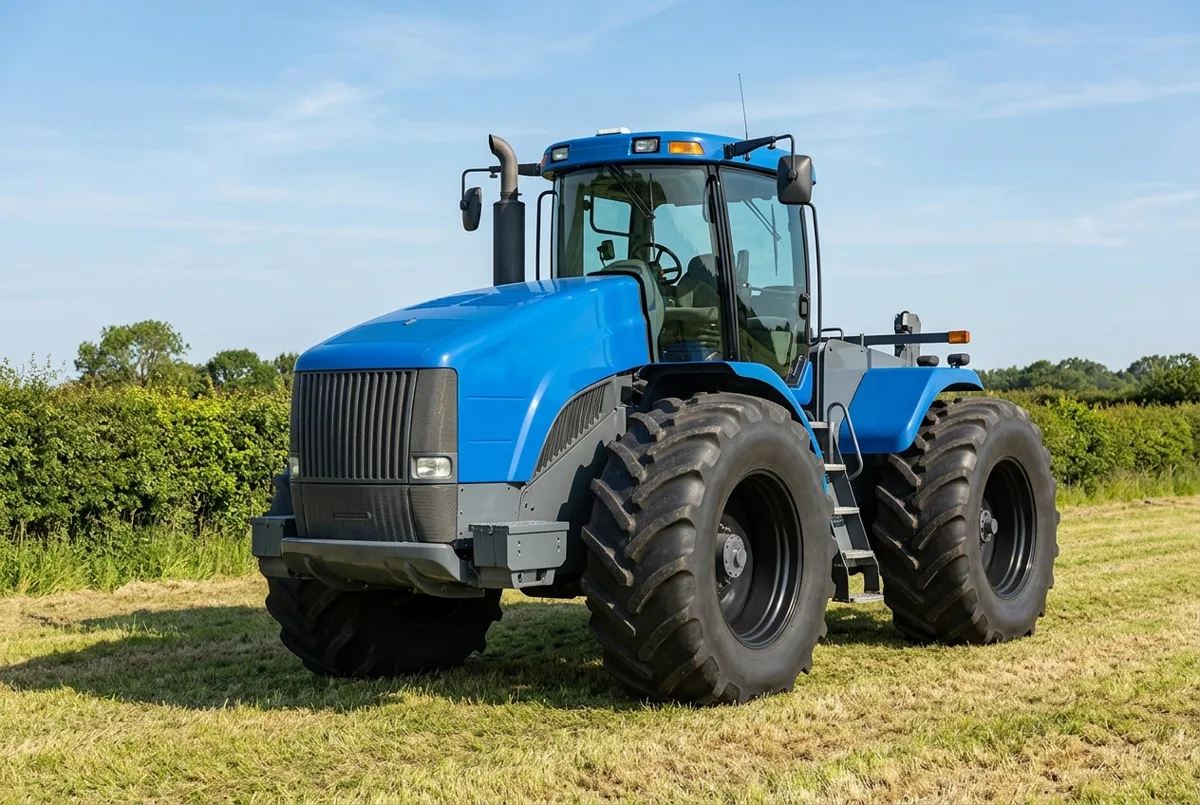
The New Holland TJ-480, one of the machines discussed below.
A tractor is hitched to a heavy drag, pulls it down a track, and whoever gets it farthest wins. That is the whole format, and everything interesting follows from one detail: the drag is built to get harder to pull the further it travels.
So a pull is not a test of whether a machine can move a weight. It is a measurement of how far it can keep moving one that is actively turning against it.
What does a run actually look like?
Short, loud, and over in a few seconds.
The track is 100 metres long and 11 metres wide. Each tractor in a class hitches to the drag, which has been loaded to a set weight for that class, and pulls. Reaching the end of the track is a full pull — the best available result, and in a well-set class it should be rare.
Where more than one tractor manages a full pull, the organisers add weight to the drag, and everyone who passed 91 metres goes into a pull-off. That is decided the same way: heavier load, same track, farthest wins. Rounds escalate until the field separates.
The drag itself is a weight transfer machine with a steel pan, and the mechanism is genuinely clever — clever enough that it has its own article here, in how a tractor pull sled works. For the purposes of watching a run, the thing to know is that resistance climbs with every metre, so a tractor that looks comfortable at the thirty-metre board can be stopped before the eighty.
Where did the sport come from?
Horses, and the oldest form of agricultural boasting there is.
Before tractors, farmers compared teams of draft horses — hitching them to a loaded hay cart or to a flat board or skid, piling on weight, usually rocks, and seeing whose team would move it farthest. The format of modern pulling is that contest with the horses replaced.
The first known competitions using motorised tractors were held in 1929, in Missouri and Kentucky. The sport became popular across the Midwestern and Southern United States in the 1950s and 1960s, and spread from there to Canada, Europe, Australia and New Zealand.
That lineage explains the format’s shape. A distance-on-a-skid contest is what you invent when the machines you have are not standardised and nobody is going to measure horsepower — you just add weight until something stops.
What are the classes?
Weight brackets, and a ladder from near-standard machines to purpose-built specials.
Classes are defined by the weight of the competing machine and by how heavily modified it may be, which is how a village event and a national meeting can run the same sled. The names that appear in the sport’s own documentation include Super Stock and Light Modified, the latter at a 5,700 lb limit, running up to the Modified classes.
At the top end the machines stop resembling tractors in any useful sense. Modified pullers are frequently multi-engined, which is why the sport gets described as the most powerful motorsport there is: the figure being produced is enormous and it only has to be sustained for a few seconds at a time. Nothing about such a machine is intended to cross a field.
The lower classes are the interesting ones for anyone who knows farm machinery, because they start from something recognisable — a real tractor, within rules on what may be altered.
Why is a full pull rarer than it sounds?
Because the tractor’s advantage runs out and the sled’s does not.
A tractor pulling hard has load transferred rearwards onto its driven wheels, which is helpful — more weight on the tyres means more grip means more pull. But that transfer is capped: push it too far and the front end lifts beyond the point of control, which is what hitch-height rules and wheelie bars exist to manage.
The sled’s weight transfer has no such cap. It is geared to distance, so it simply continues. One competitor has a finite trick and the other has an unbounded one, and the sled is designed to win if the track is long enough.
A class is set well when the strongest machine of the evening just about reaches the end. That is a judgement about weight, surface and conditions, and getting it right is most of the organiser’s job.
The surface matters more than spectators realise. The same sled on the same setting behaves differently on dirt that has been rained on, chewed up by six previous runs, or dragged flat between heats — which is why the track gets worked over between classes and why a late draw is not always a disadvantage. A pull is a contest between two machines, held on a third variable that is changing all evening.
From our database
We hold no competition machines, and this section is a reality check rather than a description of one. Our records are agricultural tractors with sourced specifications, every figure carrying its own source. Queried 2 October 2026, across 3,232 published machines:
- The heaviest machine we publish is the New Holland TJ-480 at 20,251 kg unladen, against a median of 3,185 kg.
- 110 machines exceed 250 claimed horsepower.
- 190 carry an independently measured drawbar figure, topping out at 338.9 kW — the John Deere 9620 T — with a median of 83.3 kW across all 190.
Line that up against the sport and the gap is the point. The strongest farm machine we have a measured drawbar figure for produces 338.9 kW, and it produces it all day, in a field, through a transmission designed to last twenty years. A modified puller is built to exceed that figure by a wide margin for the length of one run, and then be rebuilt.
A necessary caution about those numbers, and it is the kind this site exists for: drawbar figures here are power, in kilowatts. What a sled resists is force, in kilonewtons. We hold no drawbar pull force at all — there is no such field in our records — so these are a scale comparison and not a competition statistic. Power and force are different quantities and swapping them is the commonest way to be confidently wrong about a tractor.
To see the heavy end of ordinary machinery, try high-power tractors or browse the tractor index. For why weight on the driven wheels is what converts power into pull at all, see how do tractors work.
Common questions
- How is a tractor pull scored?
- By distance. Each tractor in a class is hitched to a drag loaded to a set weight and pulls it down the track, and the one that gets it farthest wins. Reaching the end of the 100-metre track is a full pull.
- What happens if several tractors make a full pull?
- More weight is added to the drag and the competitors who passed 91 metres go into a pull-off, which is decided the same way — whoever drags the heavier load farthest.
- When did tractor pulling start?
- It grew out of pre-industrial horse pulling contests, where farmers compared teams of draft horses on a loaded skid. The first known competitions using motorised tractors were held in 1929 in Missouri and Kentucky.
- Where is tractor pulling popular?
- It became popular across the Midwestern and Southern United States in the 1950s and 1960s, and spread from there to Canada, Europe, Australia and New Zealand.
- Are pulling tractors real farm tractors?
- The lower classes start from recognisable machines; the upper ones are purpose-built and often multi-engined. For farm-machine scale, the heaviest tractor we publish weighs 20,251 kg unladen and the highest measured drawbar power we hold is 338.9 kW.
Sources
- Tractor pulling — the track, scoring, origins and classes — Wikipedia, CC BY-SA 4.0. Retrieved . Original
- Traktorenlexikon, the model articles cited on each tractor's page — Wikibooks, CC BY-SA 4.0. Retrieved . Original
- OECD standard codes for the official testing of agricultural tractors — OECD. Drawbar and mass figures from these test reports are cited per machine on each model page, from the report records in our database; we hold no fetched copy of the OECD programme's web pages.