How a tractor pull sled works
It is a machine built to defeat whatever is towing it, and it does it with gears and gravity.
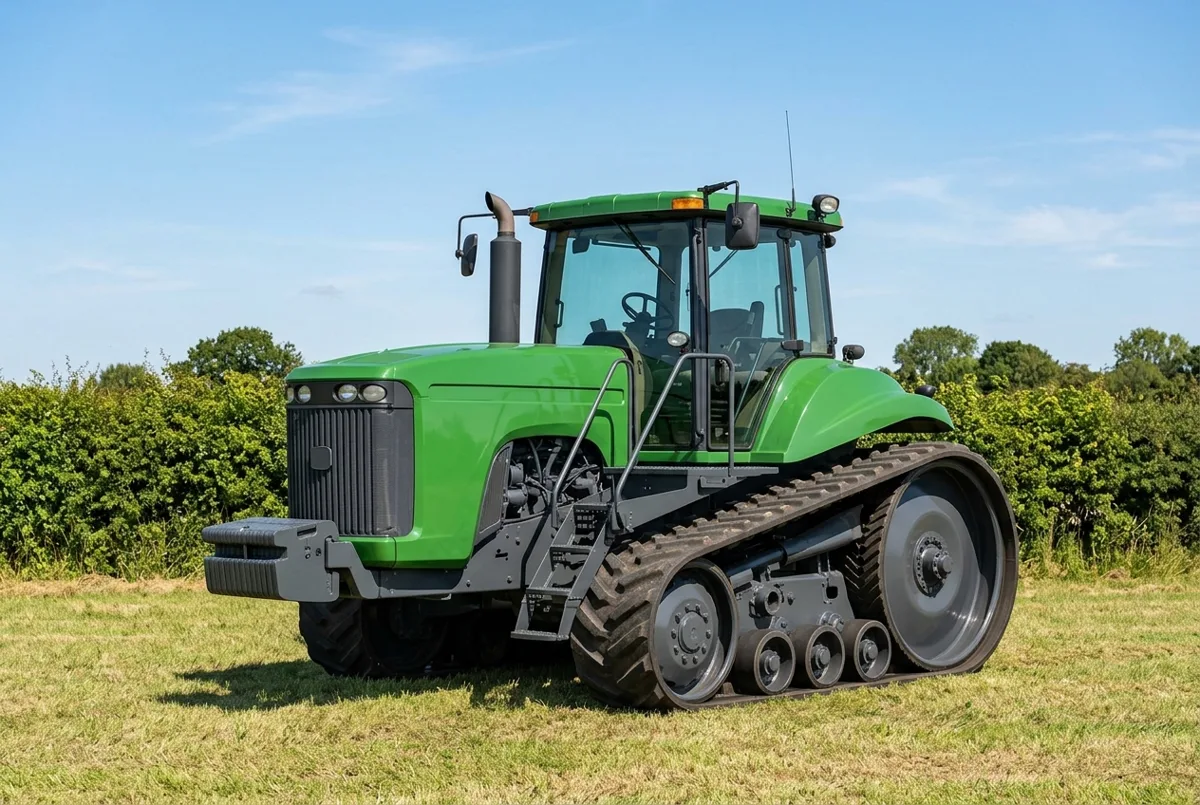
The John Deere 9620T, one of the machines discussed below.
A pulling sled is designed to beat whatever is towing it, and it does so by getting harder to pull the further it travels.
That single property is the sport. Without it you would have a tug of war with one outcome — the tractor moves the weight or it does not — and the whole thing would be over in five metres.
What is a weight transfer drag?
The proper name for the sled, and the name explains the machine.
The sled carries a large box of weight. That box is linked by gears to the sled’s own wheels, so as the sled is dragged down the track the box creeps forward — off the rear axles, towards the front of the sled. Nobody operates it. The movement is driven by the sled’s own travel, which means the further the tractor pulls, the further the weight has moved.
So the mass on board never changes. What changes is where that mass is sitting, and that turns out to matter enormously.
What is the pan, and why does it change everything?
Ahead of the rear wheels, where front wheels would be on an ordinary trailer, there is a pan — a steel plate that rides directly on the dirt.
Weight sitting over the rear axles is carried by wheels, and a wheel is a device for not dragging. Weight transferred forward onto the pan is carried by friction against the ground, and a steel plate on soil is a device for dragging very effectively indeed.
So as the box creeps forward, load moves from rolling resistance to sliding resistance. Friction rises roughly with the load pressing down, which means the pull gets steadily harder for every metre travelled. A tractor that was accelerating comfortably at twenty metres can be stopped dead at eighty without the sled having added a single kilogram.
A note on sourcing, because this site is strict about it. Wikipedia’s description of the pan and the rising resistance carries a citation needed marker. The mechanism is not controversial and it is mechanically self-evident once described, but we would rather flag that the passage is uncited than present it as firmly sourced. If you are writing a rulebook, go to the sanctioning body’s own regulations.
Why build it that way?
Because it converts a yes-or-no question into a measurement, and measurements make sport.
A fixed-weight drag sorts competitors into two buckets: those who moved it and those who did not. On a given night most of the field lands in one bucket, and the event has no resolution.
A rising-resistance sled gives every run a distance, which is a continuous number. Two machines that both “moved the weight” are separated by metres. A field of fifteen produces a ranking rather than a tie. And the organiser has a tuning knob — where the box starts, how fast it travels — so the same sled can give a close contest to garden tractors on Saturday and to multi-engined machines on Sunday.
It is a genuinely elegant piece of engineering, and almost nobody explains it, which is why it gets described as “the sled gets heavier” in nearly every account of the sport.
What is happening at the other end of the chain?
The same physics, running in the opposite direction, which is the part that makes the sport look the way it does.
A tractor’s pull is limited by what its tyres can transmit to the ground, and that is set by the load pressing them down. Horsepower that exceeds what the tyres can grip does not become pull — it becomes wheel slip, noise and a hole in the dirt. This is the ordinary farm problem too, which is why ballast exists and why water gets put in tyres.
Now add a chain pulling backwards and slightly downwards from a hitch behind the rear axle. That force rotates the whole tractor about its rear wheels: the nose lifts, and load transfers off the front axle and onto the rears. Up to a point that is helpful — more load on the driven wheels means more grip, so pulling hard makes a tractor better at pulling hard. It is a genuine positive feedback, and it is why a machine working at its limit sits nose-high.
Past that point the same effect is what ends the run. Transfer enough load rearwards and the front end comes up far enough that the machine is steering with nothing and balancing on two wheels — which is why competition classes regulate hitch height and why pullers carry long wheelie bars behind them.
So you have two machines in a tug of war, and both of them are using weight transfer as their main weapon. The sled moves load forward onto a plate to increase its drag; the tractor has load moved rearwards onto its tyres to increase its grip. Whichever runs out of its trick first, loses.
The sled has the advantage, because its weight transfer is geared to distance and cannot be exhausted, while the tractor’s is capped by the point at which it tips over backwards. That asymmetry is why a full pull is rarer than it sounds.
How is the distance judged?
By the end of the track, and then by adding weight.
The track is 100 metres long and 11 metres wide. A tractor that reaches the end has made a full pull. When more than one tractor completes the course, more weight is added to the drag, and those who passed 91 metres go into a pull-off — where the winner is simply whoever drags it farthest.
That escalation is the same idea applied to the whole evening. The sled makes each run harder as it progresses; the organisers make each round harder than the last.
From our database
We hold no competition machines. Our records are agricultural tractors with sourced specifications, and purpose-built pullers are a different world — often multi-engined, built for roughly ten seconds of work at a time. This section exists to give you the farm-machine scale to compare against, not to describe a puller.
What a sled resists is drawbar effort, and drawbar is one of the quantities independent test programmes actually measure. Queried 2 October 2026:
- We publish 190 machines with an independently measured drawbar figure, out of 3,232 in total.
- The highest measured drawbar power we hold is 338.9 kW — the John Deere 9620 T, with the Case-IH STX 440, John Deere 9520 T behind it.
- The median of those 190 is 83.3 kW, which is the more representative number and a long way below the top.
- Those measurements sit among 232 test reports behind pages you can reach.
One thing we must be careful about, and it is the kind of distinction this site exists for: those are figures in kilowatts, which is power. A sled resists with force, in kilonewtons, and we hold no drawbar pull force at all — there is no such field in our records. Power and force are different quantities, and quoting one where the other belongs is exactly the error that the rest of this site is built to avoid. So take the drawbar power figures as a scale comparison and nothing more.
For the sport itself — the classes, the track and how it started — see how tractor pulls work. To see what the heavy end of ordinary farm machinery looks like, try high-power tractors, or browse everything from the tractor index. For why weight on the driven wheels is what turns power into pull in the first place, see how do tractors work.
Common questions
- Why does a pulling sled get heavier as it moves?
- It does not get heavier — its resistance rises. The sled is a weight transfer drag, with a weight box geared to the wheels so that it creeps forward as the sled travels, shifting load off the rear axles and onto a steel pan dragging on the ground.
- What is the pan on a pulling sled?
- A metal plate mounted ahead of the rear wheels, where front wheels would otherwise be. Load transferred onto it is load carried by friction against the dirt rather than by rolling wheels, which is why resistance climbs the further the sled goes.
- What is a full pull?
- Reaching the end of the track. The track is 100 metres long and 11 metres wide, and a tractor that covers the whole distance has made a full pull. Where more than one does, weight is added and competitors who passed 91 metres go to a pull-off.
- Why not just use a very heavy sled?
- Because a fixed weight produces a fixed result — either the tractor moves it or it does not, and the contest ends in the first few metres. Rising resistance turns a yes-or-no test into a measured distance, which is what makes it a sport.
- Do farm tractors pull sleds?
- Competition machines are purpose-built, often multi-engined. For scale from our own records, the highest measured drawbar power we publish on an agricultural tractor is 338.9 kW across 190 tested machines, and the median of those is 83.3 kW.
Sources
- Tractor pulling — the weight transfer drag, the pan, the track and the full pull — Wikipedia, CC BY-SA 4.0. Retrieved . Original
- OECD standard codes for the official testing of agricultural tractors — OECD. Drawbar figures from these test reports are cited per machine on each model page, from the report records in our database; we hold no fetched copy of the OECD programme's web pages.