What tractor does Jeremy Clarkson have?
A Lamborghini, genuinely — and the badge is the least interesting thing about it.
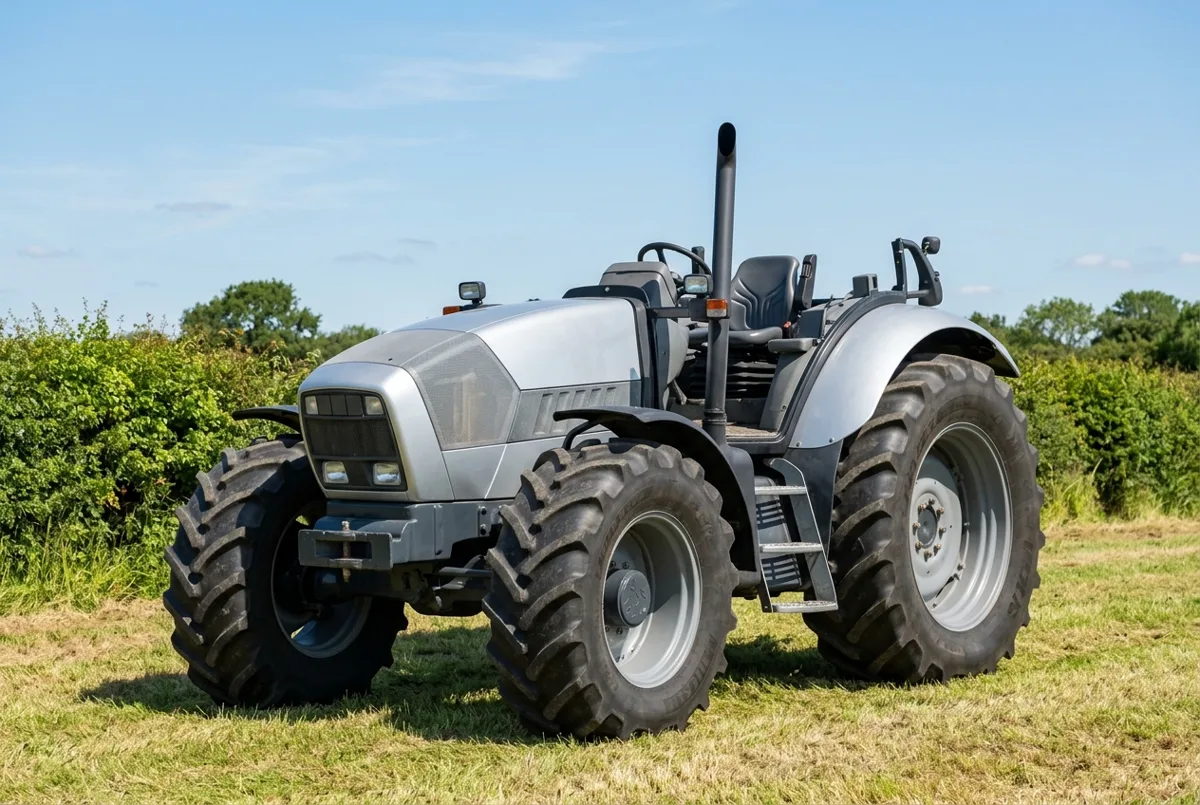
The Lamborghini R8.270, one of the machines discussed below.
A Lamborghini R8.270. He bought it second-hand for £40,000 in the first series of Clarkson’s Farm, chose it over a conventional Massey Ferguson, and then discovered it was too large and too complex for a man learning to farm to master easily.
We hold the machine itself: Lamborghini R8.270, from 2007, with its figures sourced and its claimed power named for what it actually is.
Is it really a Lamborghini?
Yes, and the tractors came first, which is the part people have backwards.
Lamborghini Trattori was founded in 1948 in Cento, Italy, by Ferruccio Lamborghini — who, as Wikipedia’s article on the firm puts it, “later went on to establish Automobili Lamborghini”. The tractor company had no long tradition behind it in the way Fiat Trattori and Landini did; it built its first machines out of discarded war materials. The 22 hp Lamborghinetta arrived in 1957.
In 1973 it became part of SAME, and today it sits inside the SDF Group alongside Deutz-Fahr, SAME and Hürlimann, with its headquarters at Pieve di Cento.
So the badge is real, the founder is the same man, and the two businesses have shared nothing but a name for more than fifty years. It remains a very good badge to have on a tractor.
Our own records bear out how long the marque has been at it. The oldest Lamborghini we publish dates from 1961 and the newest from 2009 — close to half a century of machines, from small utility tractors to the R8 range the Clarkson machine sits at the top of.
What is the R8.270, in figures?
A large machine of 2007, and our record of it is reasonably complete.
The claimed engine output is 198 kW. That number is worth pausing on, because it is where the model name comes from and it is not what an English reader assumes. 198 kW is 269 PS — metric horsepower — and 265 mechanical hp. The “270” on the bonnet is PS. Quoting it as “270 hp” converts it, quietly, into a slightly different quantity, which is the confusion this whole site exists to clear up.
The rest, from our record: 6 cylinders, 7.1 L displacement, rated at 2,350 rpm, with a torque rise of 36 %. It weighs 9,430 kg unladen, lifts 10,500 kg on the hitch, carries 585 L of fuel, and runs to 50 km/h. The wheelbase is 3,095 mm and it stands 3,270 mm tall.
Two of those figures say more than they look like saying. A torque rise of 36 % is generous, and torque rise is what lets an engine lug down into a heavy pull without the driver changing gear — the quality you feel as a machine refusing to be bogged rather than as a number on a page. And a top speed of 50 km/h puts it well past the 40 km/h line, which is not only a speed: it is the threshold at which a tractor taxed outside the agricultural class needs a goods vehicle testing certificate. Of the 3,223 published machines we hold a top speed for, only 47 exceed it, and this is one of them. See do tractors pay road tax for what sits behind that line.
We hold no engine maker for it, so this article does not name one. That is a gap in our record rather than a mystery, and saying so costs nothing.
Was it the wrong tractor?
It was too much tractor, and the programme was open about it.
Clarkson bought about a thousand acres in 2008. The land was contract-farmed by a local villager until his retirement in 2019, at which point Clarkson decided to attempt it himself. The first series opens with him buying a tractor, cultivator, seed drill and other attachments for a total of £82,000, of which the R8.270 was £40,000 — and the episode summary is blunt that he “finds that this is too large and complex for him to master easily”.
The data says the same thing from the other direction. We publish 429 machines between 120 and 180 claimed horsepower, against 110 above 250. Nearly four times as many machines sit in the band below as above it, because that is where the work is. A 200-plus-horsepower tractor earns its keep on large acreages and in contracting, where the hours justify the capital — not on awkward Cotswold parcels with tight gateways.
There is also the plain geometry of it. A tractor that will not fit through the gate is not a tractor, it is a sculpture.
How many comparable machines are there?
Sixty-one, on our own records, and the comparison is drawn on the machine’s figure rather than on its name.
Within 10% of the R8.270’s own claimed 198 kW — so 178.2 to 217.8 kW — we publish 61 machines, with a median of 194.9 kW. Banding on the machine’s sourced figure rather than on “270 hp” matters: choosing which horsepower the name meant would have been our decision dressed up as the maker’s.
That is a thin slice of the corpus. Of 3,232 published machines, sixty-one sit in this class — large tractors are a small, expensive corner of the market, and the high-power hub is correspondingly short next to the utility tractors most farms run.
What would the right tractor have been?
Something around three tonnes lighter, and our own records put a number on it.
The farm’s fields were mostly arable, growing a rotation of barley, rapeseed and wheat. That is work done, in Britain, by machines in the 120 to 200 hp band — and we publish 439 of them. Their median unladen mass is 6,604 kg, across all 439 of them, and the median hitch lift is 6,567 kg over the 301 where we hold one.
Set that against the R8.270’s 9,430 kg. It is roughly three tonnes heavier than the median machine for the job — three tonnes more to stop, to turn in a headland, to get through a gateway, and to press into Cotswold clay in a wet October. Weight is how a tractor puts power into the ground, so on the right job it is an asset. On the wrong one it is compaction and fuel.
The machines in our records that document that band best are the John Deere 6910, SAME Laser 150 DT and Case-IH MX 170 — ordinary, unglamorous, and the size of thing that actually turns a thousand acres of cereals. By contrast the 200-plus band we publish (177 machines) has a median mass of 10,727 kg, which is the scale the R8.270 was designed against.
The band boundaries there are ours, not a manufacturer’s or a standard’s — round horsepower numbers converted once to kW, published as a rule and versioned, so you can see exactly where we drew the lines and disagree with them if you like.
What happened to it?
He sold it, and he did rather well.
By the fifth series, with robots replacing older machinery on the farm, Clarkson decided to sell the original tractor. It fetched £70k at auction — against the £40,000 he paid for it second-hand several years earlier.
Machinery with a story attached has always carried a premium at farm sales. It is just unusual for the story to have been broadcast to several million people first, across five series, with the machine’s shortcomings as a running theme.
From our database
Queried 2 October 2026. We publish 98 Lamborghini tractors, spanning 1961 to 2009, every figure with its source named.
Here is the thing worth knowing about any tractor in this class, and it is the reason the site exists. The horsepower on the bonnet is almost never the horsepower at the shaft. A manufacturer quotes engine power, measured at the flywheel. What reaches the power take-off has been through the fan, the alternator and the transmission first.
Of those 98 Lamborghinis, exactly 1 carries an independent measured PTO figure. The R8.270 is not that one. For this machine we hold the maker’s claim and nothing else, and no amount of writing around it changes that.
Across the 185 machines where we do hold both a claimed engine figure and a measured PTO figure at the engine’s rated speed, the measured figure at the shaft averages 11.4% below the claim — and it was below the claim on 180 of those 185 machines. That is not a manufacturer being dishonest. It is two different quantities, quoted as though they were one.
So a reasonable expectation for an R8.270 at the shaft is meaningfully under 198 kW. We will not print a figure for it, because we do not have one. See PTO horsepower versus engine horsepower for how large that gap gets and why.
Browse the marque at Lamborghini tractors, or the whole corpus at the tractor index.
Common questions
- Is the Lamborghini tractor made by the same company as the cars?
- No, and the tractors came first. Lamborghini Trattori was founded in 1948 in Cento by Ferruccio Lamborghini, who later went on to establish Automobili Lamborghini. The tractor business became part of SAME in 1973 and sits in the SDF Group today.
- What does the 270 in R8.270 mean?
- Horsepower, but metric horsepower. Our record gives the claimed engine output as 198 kW, which works out at 269 PS and 265 mechanical hp. Quoting it as "270 hp" in English silently converts it into a slightly different quantity.
- How much did Clarkson's tractor cost?
- £40,000 second-hand, as part of £82,000 spent on a tractor, cultivator, seed drill and other attachments in the first series. By the fifth series he had decided to sell it and it fetched £70k at auction.
- What size tractor does a thousand-acre farm actually need?
- Less than this one. We hold 429 published machines between 120 and 180 hp against 110 above 250 hp, and the lower band is where the great bulk of British arable work is done. The right answer depends on soil, field size and hours rather than acreage alone.
- Does Lamborghini still make tractors?
- Yes. Lamborghini Trattori remains a live brand within the SDF Group, and we publish 98 of its machines spanning 1961 to 2009.
Sources
- Clarkson's Farm — Diddly Squat Farm, and the series 1 and series 5 episode summaries — Wikipedia, CC BY-SA 4.0. Retrieved . Original
- Lamborghini Trattori — founding, the 1973 sale to SAME, and the SDF Group today — Wikipedia, CC BY-SA 4.0. Retrieved . Original
- Traktorenlexikon, the model articles cited on each tractor's page — Wikibooks, CC BY-SA 4.0. Retrieved . Original