Which tractors are most sold
Production is not sales, and the difference is the first thing this article deals with.
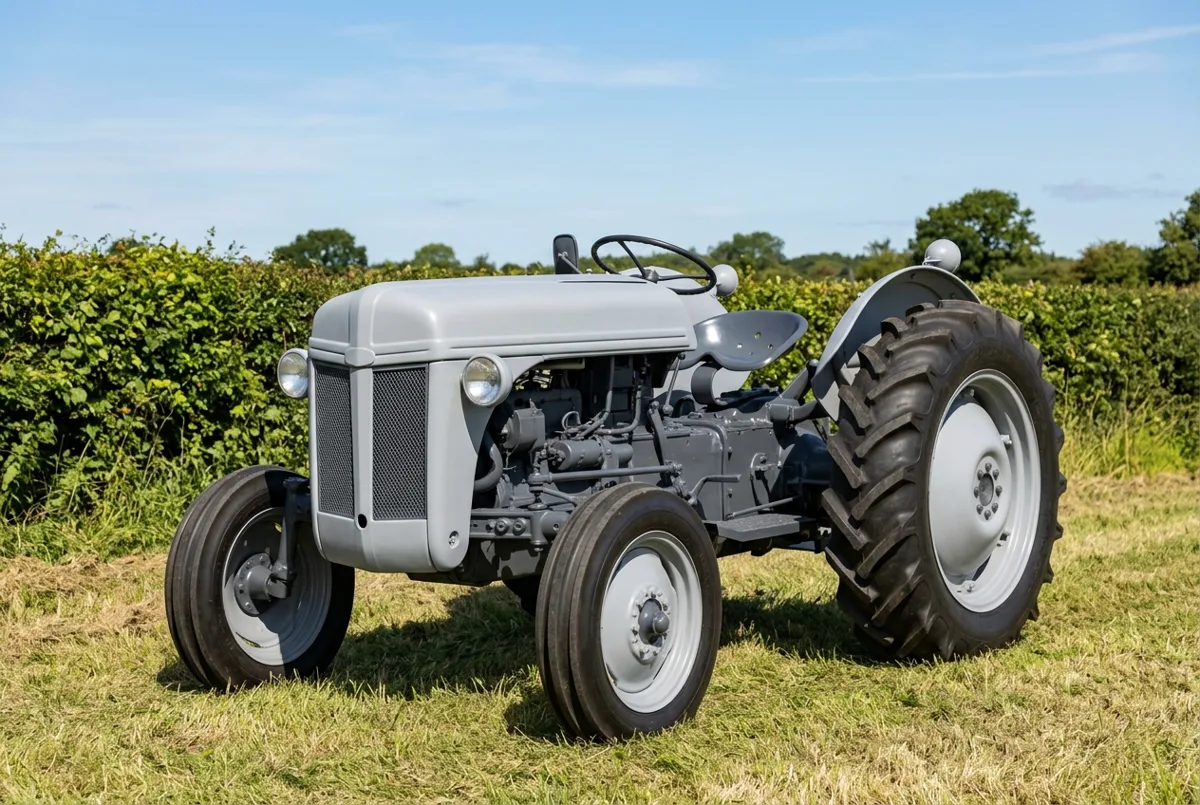
The Ford 8N, one of the machines discussed below.
The honest answer to this question starts by changing it slightly.
Per-model tractor sales are not published. No manufacturer releases audited figures for how many of a given model were bought, and the volume claims that circulate are company totals rather than model-by-model numbers. Anyone ranking tractors by sales is estimating and not saying so.
What we do hold is production — how many of a model were built — for 1,022 published machines. That is a near question with a real answer, and the difference between the two is worth a paragraph rather than a footnote.
From our database
1,022 published machines carry a sourced production figure, totalling 10,418,821 tractors built. Queried 2 October 2026.
- Ford 8 N, 1947–1952 — 500,000 built.
- International Harvester Farmall H/HV, 1939–1953 — 390,367.
- Massey Ferguson MF 135, 1964–1978 — 350,000.
- John Deere Model B, 1935–1952 — 306,000.
- John Deere Model A, 1934–1952 — 300,000.
- International Harvester Farmall M/MV, 1939–1952 — 250,213.
- International Harvester 10-20, 1923–1939 — 215,472.
- International Harvester CUB, 1947–1958 — 210,940.
- ALLIS-CHALMERS WC, 1933–1948 — 178,202.
- John Deere Model D, 1923–1953 — 157,258.
The median tells you more than the top ten does. Across all 1,022 machines the median production run is 1,557. Only 17 models passed 100,000 and none passed a million. The famous machines above are not typical of tractor production — they are the handful of designs that happened to meet a moment, and almost everything else was built in the low thousands and then replaced.
Two cautions on the list. These are figures published for a model over its whole production run, so a long run flatters a design that sold steadily over a short one that sold hard. And a model recorded by one source as a single machine may be recorded by another as two variants, which moves a number without anything about the tractor changing.
A figure that survives is not a figure that is typical. The 1,022 machines carrying a production number are not a random sample of the 3,232 we publish. A model gets its total recorded and republished because it mattered — because a marque history was written about it, or a preservation society counted them. The tractors nobody wrote a book about are the ones missing from this list, and there are far more of them.
That is why the median matters more than the ranking. 1,557 is what an ordinary production run looked like among the models well known enough to have been counted at all. The true median across every tractor ever built is lower, and we cannot tell you by how much.
Why can nobody tell you the best-selling tractor?
Because the number is not collected anywhere a reader can reach.
Registration data exists in some countries and covers machines put on the road in that country in that year, which is neither global nor lifetime. Manufacturer announcements cover company volumes, not models. Dealer records are private. Put together, there is no path from any of these to a ranked list of models by units sold, and the articles presenting one have made it up or copied somebody who did.
Production figures survive because they were recorded at the factory and published in histories afterwards, which is why they are the number this article can stand behind.
Who is the largest tractor manufacturer?
We are not going to tell you, and the reason is the same reason the rest of this article is worth reading.
A company-wide production total has exactly one origin: the company. There is no audited register of tractors built, no regulator collecting the figure, and no independent body with any reason to count. So the honest answer to this question is always “according to the manufacturer” — and a figure we have taken from a manufacturer’s own announcement, which we have not read ourselves, is not a sourced figure. It is a number we heard.
This site holds the large makers at arm’s length deliberately. Nothing is taken from them without written permission, so where a figure exists only in a maker’s own press release, we do not have it, and we would rather say that than print it with a plausible-looking link underneath.
What we can tell you is what our own records hold, and the honest caveat on the list above is that the machines in them are overwhelmingly European and American. It describes the tractors we have sourced specifications for, not the industry. India builds more tractors than anywhere else and we publish almost none of them — a gap in our coverage, stated as one, rather than filled in with somebody else’s marketing.
What made the big sellers sell?
Price, timing, and being the right size for a farm that was changing.
The Ford 8 N is the clearest case. It arrived as small farms were mechanising, it carried a three-point linkage that made implements interchangeable, and it cost what a farm could find. 500,000 were built in 1947–1952 — five years.
The pattern repeats down the list. The machines that sold in six figures were mid-sized, simple, and launched into a mechanising market. None of them was the most powerful tractor of its day, and several were among the least.
Does a long production run mean a good tractor?
Not on its own, and the dates above show why.
Several of the machines on that list ran for twelve or fifteen years with the same designation, and a long run flatters a design in a ranking by total units. A tractor built for fifteen years at a modest rate can finish ahead of one that sold furiously for four, and the second was the more successful machine by any measure a dealer would recognise.
The Ford 8 N is the exception that makes the point. 500,000 in 1947–1952 is a rate nothing else on the list approaches, and that rate — rather than the total — is what made it the machine that mechanised small farms.
What should you take from a production figure?
That parts exist, and that somebody else has solved your problem already.
A model built in six figures has a parts supply, a repair literature and an owner community decades after it left the factory, and that is worth more on a working farm than a specification advantage. A model built in the low hundreds may be the better machine and still be the worse purchase.
Every figure here is sourced on the machine’s own page — see the tractor index — and our data methodology sets out what has to be true before any of it publishes. For the machines where a laboratory measured the power rather than the maker claiming it, the PTO horsepower list is the place to start.
Common questions
- Which tractor has sold the most ever?
- Nobody can answer that from published data, because per-model sales figures are not audited or released. What can be answered is which models were built in the largest numbers, and in our records that is the Ford 8N at 500,000 between 1947 and 1952.
- Who is the biggest tractor manufacturer in the world?
- We hold no figure we can source, so we do not publish one. Company-wide production totals come from manufacturers' own announcements, and the large makers are ones this site does not take material from without written permission. What we can say is what our own records hold, and they are overwhelmingly European and American rather than a picture of the industry.
- Is production the same as sales?
- No. Production counts machines built, sales count machines bought, and the two differ by stock, by exports recorded elsewhere, and by machines built for a market that did not take them. Any article presenting one as the other is wrong in a way that is hard to spot.
Sources
- Traktorenlexikon, the model articles cited on each tractor's page — Wikibooks, CC BY-SA 4.0. Retrieved . Original