Do tractors need an MOT?
The flat answer is no. The useful answer has a second sentence attached to it.
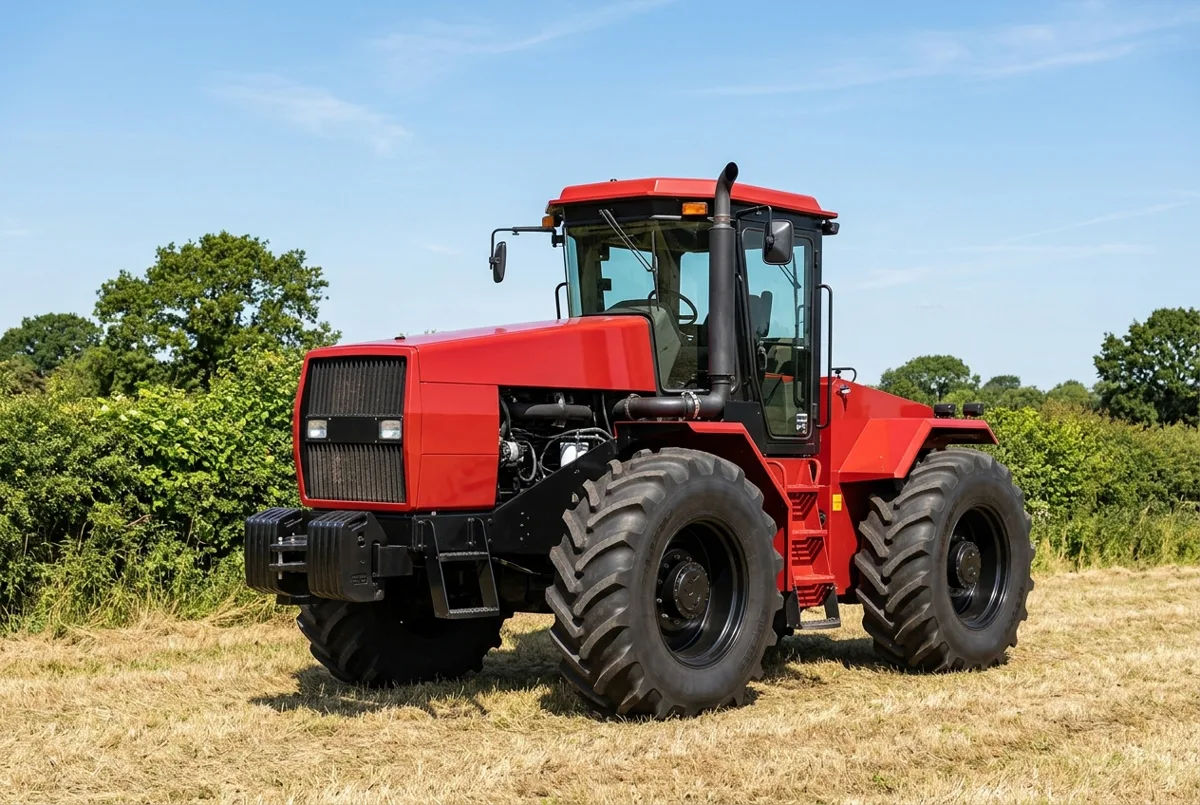
The Case-IH 9370, one of the machines discussed below.
No. GOV.UK’s list of vehicles that do not need an MOT names tractors outright, with no conditions stated on that page.
The second sentence is the one that matters, and most answers to this question leave it out: the exemption is attached to what the tractor is used for, and a tractor doing something else can find itself inside a testing regime after all.
What does GOV.UK actually say?
Two documents, at two levels of detail, and they do not contradict each other.
The consumer page is a flat list. Under “Vehicles that do not need an MOT” it gives “goods vehicles powered by electricity and registered before 1 March 2015”, “tractors”, and “some historic (‘classic’) vehicles”. It adds that the exempt types are set out on the MOT exemption form (V112), which has to be completed in order to tax the vehicle or apply for tax exemption. Lorries, buses and trailers take an annual vehicle test instead of an MOT.
The Department for Transport’s guide puts the same exemption in terms of the tax class:
“Tractors that are used solely for agriculture, horticulture or forestry (tractors eligible to be taxed in the agricultural tax class) are exempt from roadworthiness testing.”
Read those two together and the shape is clear. The flat “tractors” on the consumer page is a shorthand for the agricultural tax class, and the guide spells out what happens when a machine is not in it.
When does a tractor need a test after all?
When it is taxed outside the agricultural class and two further conditions are both met.
The guide is specific. Tractors taxed in any other tax class must hold a valid goods vehicle testing certificate if they:
“are capable by construction of exceeding 40 km/h (around 25 mph)”
and
“are used to haul goods (of any description) more than 15 miles from their operating base (which is not necessarily where they are registered)”
Three things in that are worth slowing down for.
“Capable by construction.” The guide adds: “this applies to tractors capable of exceeding 40 km/h, even if they are not permitted to exceed 40 km/h”, and tells you to consult the manufacturer if you are unsure. A speed limiter does not take a machine out of the condition. What the tractor was built to do is the test.
“Of any description.” Not agricultural goods. Not goods for reward. Any goods.
“From their operating base.” Not from where it is registered, which the guide points out explicitly — a detail that will catch anyone running machines from a yard that is not the registered address.
This lands on contractors, not on farms. A tractor that stays in the agricultural class and does farm work is outside testing entirely. A tractor registered for general haulage, fast enough, going far enough, is in the goods vehicle testing regime operated by DVSA.
Does the tax class change anything else?
It changes the fuel, which is the expensive part.
The same family of rules governs rebated fuel, and the connection is direct: the class a tractor is registered in decides what it may run on. A tractor “designed and constructed primarily for off-road use” is an excepted vehicle and may use red diesel for farming work, verge cutting and hedge or tree cutting. But:
“Tractors with a vehicle excise licence - such as a general haulage vehicle - cannot use red diesel either on or off public roads, regardless of whether it is undertaking agricultural, horticultural or forestry work.”
Regardless of whether it is undertaking agricultural work. So the decision that puts a machine into a testing regime is the same decision that takes away its red diesel, and both follow from the tax class rather than from the job. Do tractors pay road tax covers that side of it, including the 1.5 kilometre rule.
What applies instead of a test?
Rather a lot, and the width rules are the ones people genuinely do not know about.
Speed limits by width. The guide sets lower road speed limits for wider machines — “vehicles between 2.55 metres and 3.5 metres are limited to 20 mph (around 32 km/h)” and “vehicles between 3.5 metres to 4.3 metres are limited to 12 mph (around 19 km/h)”. It also warns that “as a general rule, vehicles wider than 3.0 metres must notify police of their journeys, and vehicles wider than 3.5 metres must also have attendants to escort the vehicle”. The measurement “includes tyres, including when added by the customer, and any towed implement or trailer” — so a tyre upgrade can move a machine into a lower bracket.
The guide then says the thing worth acting on: “It is sensible to check your tractor width as many ‘conventional’ but larger tractors may fall into the 20 mph speed bracket.”
Testing cadence, if you are in the regime. First test four years after first registration, then every two years, and “at test, tractors will be expected to meet the higher construction standards of tractors that may travel above 40 km/h”.
The trailer is assessed separately. “If a trailer is not used solely for an agricultural, horticulture or forestry purpose it is not exempt from goods vehicle testing, even if towed by a tractor.” An exempt tractor does not make its trailer exempt.
Operator licensing. A goods vehicle operator’s licence may be needed above 3.5 tonnes maximum authorised mass, including tractor and trailer combinations. The two exemptions most likely to apply are a tractor “used solely for moving farming implements or articles (any distance), provided the tractor operator owns or is employed by the relevant farm”, or one “used to haul farm produce within 15 miles (24.14 km) of the farm or forestry estate”.
Tachographs. A tractor used for commercial non-agricultural haulage may fall under EU drivers’ hours rules, with limits on driving time and minimum breaks and rest.
None of that is an MOT. All of it is an obligation, and the pattern is consistent: the moment a tractor stops being a farm machine doing farm work, several regimes arrive at once.
Is it the same across the UK?
No, and GOV.UK says so on the MOT page itself: “There are different rules and processes in Northern Ireland for MOTs for vehicles registered in Northern Ireland.”
It also notes a quirk worth knowing if a machine moves: where a vehicle’s last MOT was in Northern Ireland and its next test is in Great Britain, the renewal date is based on the date of the GB test rather than carrying over.
From our database
No test certificate means no annual outside check, and the question that actually follows is how old the machines are. Queried 2 October 2026, across 3,232 published machines, every one carrying a sourced start year:
- The median machine was introduced in 1983 — 43 years ago.
- 2,810 of 3,232 are at least 25 years old, 1,846 are at least 40, and 1,234 are at least 50.
- Only 422 were introduced within the last 25 years.
- The busiest decades in our records are the 1990s (680), the 1980s (610), the 1970s (531).
- The range runs from 1913 to 2023.
And on the width question the guide tells you to go and check, across the 3,186 machines where we hold an overall width:
- 226 are 2.55 metres or wider, which puts them in the 20 mph bracket rather than the ordinary 40 km/h one.
- 28 are 3.5 metres or wider — the 12 mph bracket, and the same machines that would need attendants to escort them.
- 87 exceed 3.0 metres, the point at which journeys are to be notified to the police.
- The median machine is 1,960 mm wide and the widest we publish is 4,023 mm — the Case-IH 9370, with the Case-IH 9370, Case-IH 9380 and the Case-IH 9270 behind it.
Those width counts are a floor, not a ceiling, and that is not hedging. The guide measures width including tyres as fitted and any towed implement, while our figure is the machine’s own recorded width — so a tractor under 2.55 metres on our record can be over it on a wider tyre option, or with an implement mounted. More machines are affected than the number says, never fewer.
One honest caveat on all of that: these are the years the model was introduced, not the age of any particular machine. A 1975 model may have been built in 1979 and may be working this afternoon. Our coverage also skews towards older machinery, because that is where the documented sources are, so this describes our records rather than the national fleet.
What it does establish is scale. The machines this exemption applies to are overwhelmingly not new, and a 40-year-old tractor with no test obligation is checked by exactly one person. Brakes, steering, lights, hitch and tyres on a machine towing a loaded trailer on a public road are the owner’s responsibility and nobody else’s, and that is a more useful thing to take away than a certificate you do not need.
Browse by era in the tractor index, see what the working middle of the market looks like in utility tractors, or read how tractor brakes work for the system that matters most on a road with a trailer behind you.
This is not legal advice. The rules differ between Great Britain and Northern Ireland and they change. Every quotation above is linked in the sources below — check the current page before acting on any of it.
Common questions
- Are tractors exempt from the MOT?
- Yes. GOV.UK's list of vehicles that do not need an MOT includes tractors, alongside electric goods vehicles registered before 1 March 2015 and some historic vehicles. The exempt types are listed on form V112, which has to be filled in to tax the vehicle or claim tax exemption.
- When does a tractor need a test after all?
- When it is taxed outside the agricultural class and meets two conditions together — it is capable by construction of exceeding 40 km/h, and it is used to haul goods more than 15 miles from its operating base. Then it needs a goods vehicle testing certificate rather than an MOT.
- Does it count if the tractor is limited to 40 km/h?
- No. The guidance says the condition applies to tractors capable of exceeding 40 km/h even if they are not permitted to exceed it, and advises consulting the manufacturer where you are not sure. Capability by construction is the test, not the setting.
- Is it the same in Northern Ireland?
- Not necessarily. GOV.UK states plainly that there are different rules and processes in Northern Ireland for MOTs for vehicles registered there. Check the Northern Ireland guidance rather than assuming the Great Britain position carries across.
- If there is no test, who checks the tractor?
- You do. That is the real consequence of the exemption, and it matters more than it sounds because the fleet is old — the median machine in our records was introduced in 1983, and 2,810 of 3,232 are at least 25 years old.
Sources
- Getting an MOT: vehicles that do not need an MOT — GOV.UK (DVSA), Open Government Licence v3.0. Retrieved . Original
- Tractors and regulatory requirements: a brief guide, September 2017 — GOV.UK (Department for Transport), Open Government Licence v3.0. Retrieved . Original
- Agricultural vehicle licences, tax information and fuel — GOV.UK, Open Government Licence v3.0. Retrieved . Original
- Traktorenlexikon, the model articles cited on each tractor's page — Wikibooks, CC BY-SA 4.0. Retrieved . Original